Grid EA What is it? How it works and the risks you need to know
EA Most gold trading uses a Grid system because it wins often and profits look steady. But the risk hides in the days when the price runs one way without stopping. This article uses real numbers to show how fast the risk grows and how to control it.
Grid EA What is it
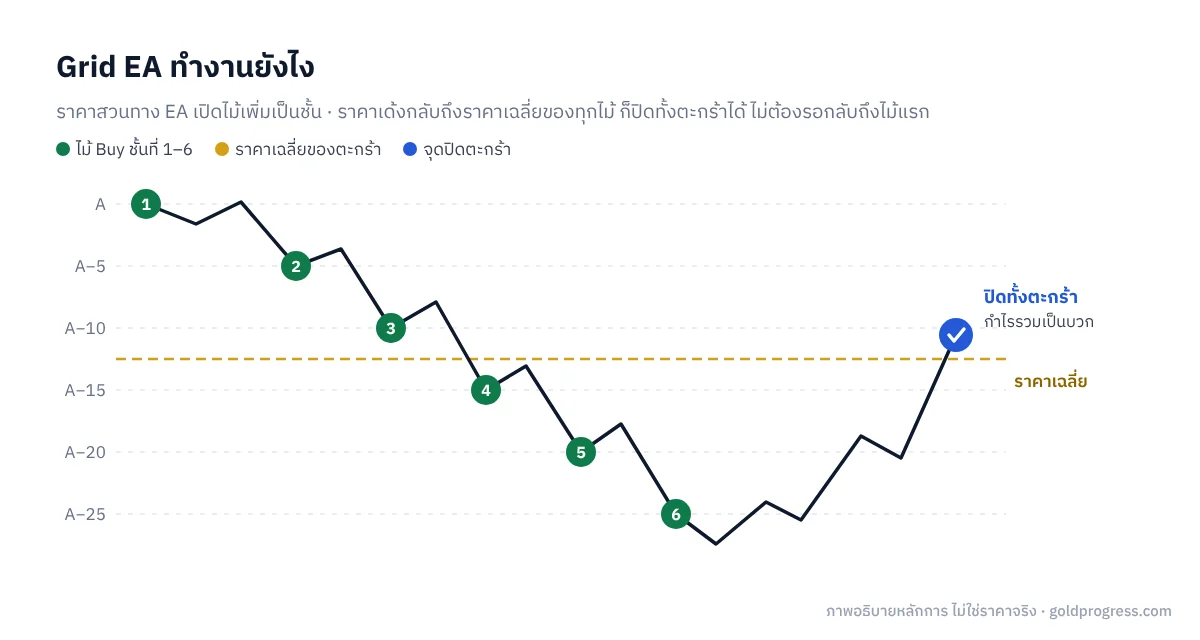
Grid EA is an EA that opens additional orders in layers (like a table, or grid) every time the price moves against the first order by a set distance, thencloses all orders at once as a basketwhen total profit reaches the target.
Example: the EA opens a first Buy. If the price drops 5 dollars, it opens a 2nd Buy; another 5 dollars lower, a 3rd, and so on. When the price bounces back up tothe average price of all orders (plus a small profit distance), the EA closes the whole basket in profit, without waiting for the price to return to the first order.
Why do Grid EAs win so often
Gold prices usually swing up and down and rarely run one way for long without a pause. A Grid system relies on small bounces to close baskets, so itwins most of the time and the profit curve often rises in a nice line.
A Grid system makes many small profits in exchange for the chance of a big loss on days when the price runs one way for a long time. Such days are rare, but when they happen and the capital cannot take it, you can lose several months of profit or all your capital at once.
Example figures: how fast floating loss grows
Suppose a standard account where the EA opens Buy 0.01 lot per order, the same for every order Spacing of 5 dollars per layer (a 0.01 lot order loses about 1 USD per 1 dollar the price falls)
| Price drop from the first order | Number of orders | Approximate total floating loss |
|---|---|---|
| 10 dollars | 3 | 15 USD |
| 25 dollars | 6 | 75 USD |
| 50 dollars | 11 | 275 USD |
| 100 dollars | 21 | 1,050 USD |
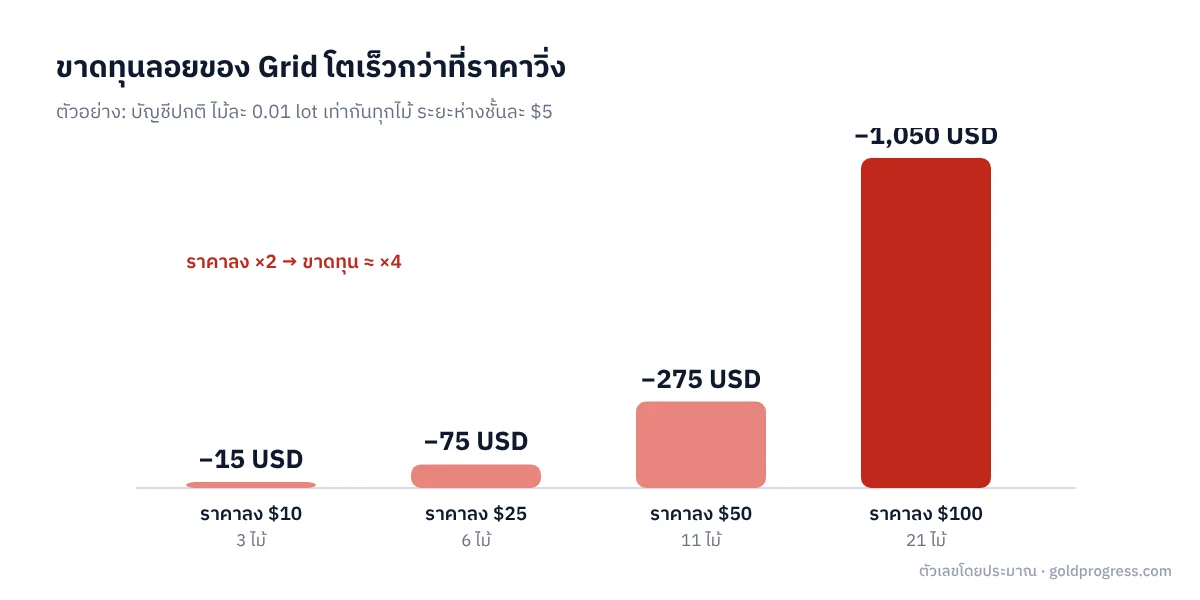
Notice that the price drop doubles (50 → 100 dollars), but the floating loss grows by almost 4 times (275 → 1,050 USD) because every open order is losing at the same time, and new orders keep being added.
If you EA increase the lot on the next orders (Martingale-style, for example multiplying by 1.5 at every layer), the floating loss grows much faster than this table. A gold move of 50–100 dollars in a few days can happen, especially around major US economic news.
What determines the risk of Grid EA
- Lot per order versus capital: The most important factor. A lot that is too large for the capital is the main cause of blown accounts.
- Spacing between layers: Too tight and orders are added quickly; too wide and the basket is hard to close.
- Lot increase on recovery orders (multiplier): The higher the multiplier, the higher the risk.
- Maximum number of layers: If unlimited, orders keep being added until the capital runs out.
- Timing of the first order: Opening the first order against a strongly moving market means starting the basket at the riskiest point.
- News and holidays: Price jumps during major news or after the Monday market open can make the set layer spacing not work as planned.
How to control risk when using Grid EA
- Use a lot that fits your capital and do not raise it yourself If your capital is small, use aCent account so that your capital can support many layers.
- Set a maximum floating-loss protection and understand what happens when it is reached (stop adding orders, or close the basket and take the real loss).
- Be careful around major news such as US jobs data (NFP), inflation (CPI) and interest-rate meetings (FOMC)
- Look at drawdown, not only profit Every month, check how deep the floating loss got. If it keeps getting deeper, it is a sign the lot may be too large for current market conditions.
- Grow by adding accounts, not by raising lot Open a new account with new capital once the first account has at least 2–3 months of real results.
- Use only money you can afford to lose Every account running the same set of EAs can lose at the same time.
- Use a separate account for a grid EA Don't trade manually or run other EAs on the same account. All orders share the same margin, so losing trades elsewhere eat into the room the grid basket needs for recovery orders, and they make the EA's results hard to read.
Gold Progress How does it help control Grid risk
EA by Gold Progress is a grid system, so every risk described in this article applies. What we added to help reduce the risk::
- AI First-order check: Before starting a new basket, the AI checks whether the market is moving strongly against it. If so, it waits, reducing the chance of starting a basket at the riskiest point.
- AI Team manager: If the market runs strongly one way, it pauses the side that goes against the market, then reopens when it is safe.
- Floating-loss protection 30% (default): When the threshold is reached, the EA stops placing more recovery orders.
- Gold Office: See each EA's floating loss live, and pause, close orders or set close-at-breakeven instantly from your phone.
- A clear lot-per-capital table and the EA sets the starting lot automatically by account type.
All of this helps you control things better, but it does not guarantee you will not lose. Read more atRisk Warning
Try the EAs on your real account
Open Gold Office free for 14 days with full access including AI, and watch the team work live from your phone.
Start the free 14-day trial No card required · no automatic charge after 14 days · your money stays in your broker accountRead more
 Basics EA
EA What is it? Get to know gold-trading EAs on MT5 before you start
How do automated trading programs on MT5 work, what types are there, what do you need to prepare, and how to choose a safe EA
 Trading account
What is a Cent account? How it suits gold EAs with small capital
Deposit 1 dollar and get 100 USC. Why it suits small capital and Grid EAs, how to think about lots, and what to watch for
This article is general information, not investment advice. Trading gold is high-risk and you may lose the entire balance of your account. ReadRisk Warningbefore you start